
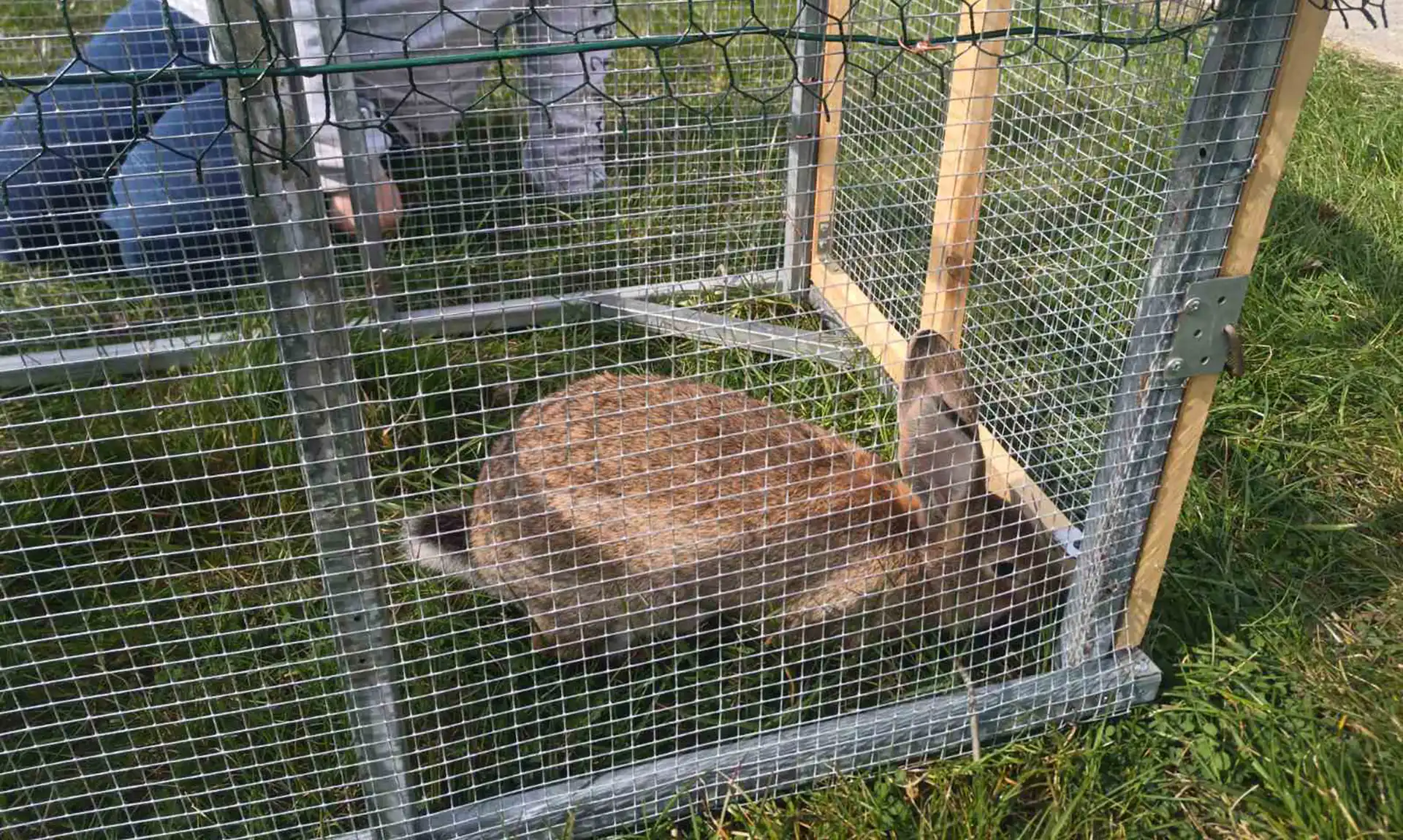
The First Rabbit Hutches Are Completed
The First Rabbit Hutches Are Completed
UUSTEE Stories — Growth and Recovery
On the grounds of the UUSTEE recovery and rehabilitation centre in Loksa, something has taken shape that looks, at first glance, like a simple wooden structure — but which carries far more meaning than that. Built by the hands of one participant, the organisation’s first rabbit hutch is now complete: a structure that symbolizes something much bigger than shelter for animals. It is a step-by-step proof that through care, consistency, and work therapy, it is possible to build not only a small homestead, but also trust in oneself.
Why a Rabbit Hutch?
UUSTEE’s mission is to help people struggling with alcohol and drug dependency find their way back to sobriety and a full life. That path is not made of conversations and support groups alone — daily, practical work plays an equally important role, giving participants structure, responsibility, and a tangible result to point to. It was from this idea that the plan grew to establish a small homestead on the centre’s grounds, where participants could learn animal care, construction skills, and the steady discipline of looking after something living.
Rabbits were chosen as the first step for good reason: caring for them demands regularity and routine — feeding, cleaning, monitoring — without requiring overly advanced skills right from the start. That made the rabbit hutch the ideal first project, one where a participant could practise both hands-on craft skills and a sense of responsibility at the same time.
The Building Process
Building the hutch was no simple task. The participant responsible for the project had no prior experience with carpentry or building shelters for animals. Every stage — preparing the foundation and base, assembling the frame, raising the walls and roof, ensuring ventilation and light, and fitting out the cages and interior to keep the animals safe — meant learning new skills on the go.
Mentors at the centre and fellow participants offered support, but the core work and responsibility rested with one person. That was not incidental: UUSTEE’s approach to work therapy is built precisely on the principle that a participant sees a project through from start to finish and carries personal responsibility for it. In doing so, what gets built is not only a physical structure, but also a quieter, internal kind of confidence — the knowledge that I am capable of finishing something I started.
The Value of Work Therapy
Work therapy is a well-established method in recovery and rehabilitation practice. Recovering from addiction often means rebuilding a sense of self-worth and confidence that has been lost along the way. For someone who has lived for years amid chaos and instability, work with a tangible, visible outcome — a completed building — is something whose value is hard to overstate.
“Tasks like this are part of work therapy: a person sees the result of their own work and experiences that their skills and contribution have real value,” as UUSTEE describes its approach. That sentence captures the essence of the entire homestead project. The rabbit hutch is not simply a structure for animals — it is proof that a participant’s skills and effort are real and worth something.
From the First House Onward
The completion of the rabbit hutch was not an isolated event. It marked the beginning of a broader effort to build up the homestead on the centre’s grounds. The next step soon followed — a chicken coop, which was later completed as well and delivered its own first result: the first egg found in the nest. Step by step, a small but meaningful homestead is growing at UUSTEE, where every new structure and every new animal carries the same message: consistent work and care lead to real, visible results.
The first rabbit hutches are a small but significant chapter in the story of the UUSTEE centre in Loksa. They are a reminder that recovery is not built through words alone — it is built day by day, board by board, hand by hand. Every completed structure stands as proof that change is possible, and that through care, work, and gradual growth, a person finds their way back not only to sobriety, but to themselves.
UUSTEE — the road to sobriety and a new life through care, work, and gradual recovery.